
Protein Molecular Weight Markers

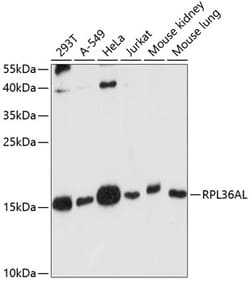
ABclonal Technology RPL36AL Rabbit pAb

Cytoplasmic ribosomes, organelles that catalyze protein synthesis, consist of a small 40S subunit and a large 60S subunit. Together these subunits are composed of 4 RNA species and approximately 80 structurally distinct proteins. This gene encodes a ribosomal protein that is a component of the 60S subunit. The protein, which shares sequence similarity with yeast ribosomal protein L44, belongs to the L44E (L36AE) family of ribosomal proteins. This gene and the human gene officially named ribosomal protein L36a (RPL36A) encode nearly identical proteins, however, they are distinct genes. Although the name of this gene has been referred to as ribosomal protein L36a (RPL36A), its official name is ribosomal protein L36a-like (RPL36AL). As is typical for genes encoding ribosomal proteins, there are multiple processed pseudogenes of this gene dispersed through the genome.

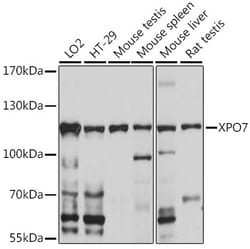
ABclonal Technology XPO7 Rabbit pAb
The transport of protein and large RNAs through the nuclear pore complexes (NPC) is an energy-dependent and regulated process. The import of proteins with a nuclear localization signal (NLS) is accomplished by recognition of one or more clusters of basic amino acids by the importin-alpha/beta complex, see MIM 600685 and MIM 602738. The small GTPase RAN (MIM 601179) plays a key role in NLS-dependent protein import. RAN-binding protein-16 is a member of the importin-beta superfamily of nuclear transport receptors.
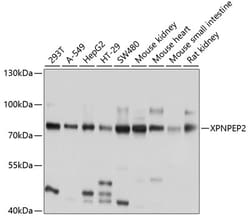
ABclonal Technology XPNPEP2 Rabbit pAb
Aminopeptidase P is a hydrolase specific for N-terminal imido bonds, which are common to several collagen degradation products, neuropeptides, vasoactive peptides, and cytokines. Structurally, the enzyme is a member of the pita bread fold family and occurs in mammalian tissues in both soluble and GPI-anchored membrane-bound forms. A membrane-bound and soluble form of this enzyme have been identified as products of two separate genes.
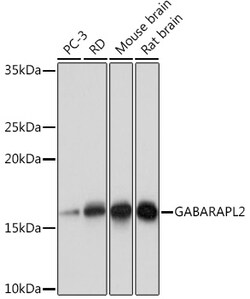
ABclonal Technology GABARAPL2 Rabbit mAb
Enables ubiquitin protein ligase binding activity. Involved in negative regulation of proteasomal protein catabolic process and protein localization to endoplasmic reticulum. Located in Golgi membrane and autophagosome membrane.
![ABclonal Technology [KO Validated] CHRAC1 Rabbit pAb](https://assets.fishersci.com/TFS-Assets/CCG/product-images/5000105257.jpg-250.jpg)
ABclonal Technology [KO Validated] CHRAC1 Rabbit pAb
CHRAC1 is a histone-fold protein that interacts with other histone-fold proteins to bind DNA in a sequence-independent manner. These histone-fold protein dimers combine within larger enzymatic complexes for DNA transcription, replication, and packaging.
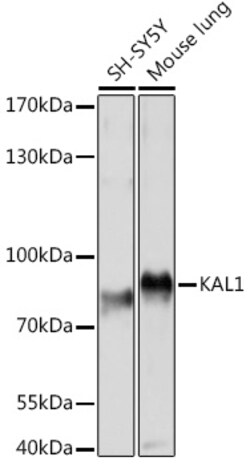
ABclonal Technology KAL1 Rabbit pAb
Mutations in this gene cause the X-linked Kallmann syndrome. The encoded protein is similar in sequence to proteins known to function in neural cell adhesion and axonal migration. In addition, this cell surface protein is N-glycosylated and may have anti-protease activity.
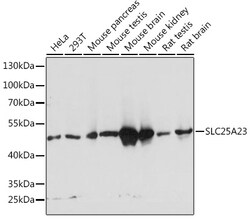
ABclonal Technology SLC25A23 Rabbit pAb
Predicted to enable ATP transmembrane transporter activity. Involved in calcium import into the mitochondrion, positive regulation of mitochondrial calcium ion concentration, and regulation of cellular hyperosmotic salinity response. Located in mitochondrion.
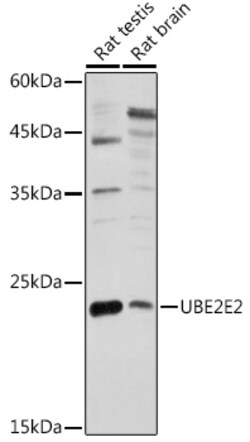
ABclonal Technology UBE2E2 Rabbit pAb
Enables ISG15 transferase activity and ubiquitin conjugating enzyme activity. Involved in protein modification by small protein conjugation. Acts upstream of or within cellular response to DNA damage stimulus and positive regulation of G1/S transition of mitotic cell cycle. Predicted to be active in nucleus.
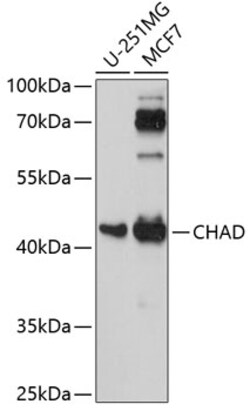
ABclonal Technology CHAD Rabbit pAb
Chondroadherin is a cartilage matrix protein thought to mediate adhesion of isolated chondrocytes. The protein contains 11 leucine-rich repeats flanked by cysteine-rich regions. The chondroadherin messenger RNA is present in chondrocytes at all ages.
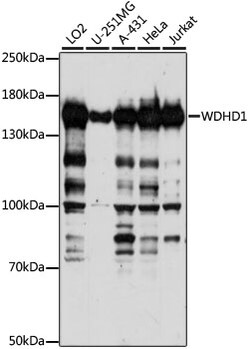
ABclonal Technology WDHD1 Rabbit pAb
The protein encoded by this gene contains multiple N-terminal WD40 domains and a C-terminal high mobility group (HMG) box. WD40 domains are found in a variety of eukaryotic proteins and may function as adaptor/regulatory modules in signal transduction, pre-mRNA processing and cytoskeleton assembly. HMG boxes are found in many eukaryotic proteins involved in chromatin assembly, transcription and replication. Alternative splicing results in two transcript variants encoding different isoforms.
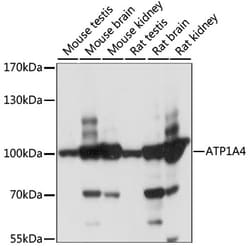
ABclonal Technology ATP1A4 Rabbit pAb
The protein encoded by this gene belongs to the family of P-type cation transport ATPases, and to the subfamily of Na+/K+ -ATPases. Na+/K+ -ATPase is an integral membrane protein responsible for establishing and maintaining the electrochemical gradients of Na and K ions across the plasma membrane. These gradients are essential for osmoregulation, for sodium-coupled transport of a variety of organic and inorganic molecules, and for electrical excitability of nerve and muscle. This enzyme is composed of two subunits, a large catalytic subunit (alpha) and a smaller glycoprotein subunit (beta). The catalytic subunit of Na+/K+ -ATPase is encoded by multiple genes. This gene encodes an alpha 4 subunit. Alternatively spliced transcript variants encoding different isoforms have been identified.
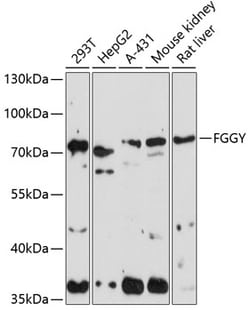
ABclonal Technology FGGY Rabbit pAb
This gene encodes a protein that phosphorylates carbohydrates such as ribulose, ribitol, and L-arabinitol. Genome-wide association studies in some populations have found an association between polymorphisms in this gene and sporadic amyotrophic lateral sclerosis, but studies of other populations have not been able to replicate this association. Alternative splicing results in multiple transcript variants.
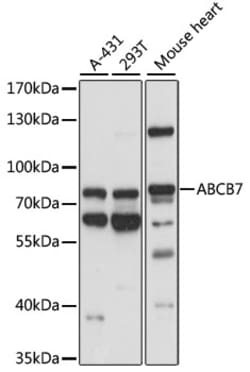
ABclonal Technology ABCB7 Rabbit pAb
The membrane-associated protein encoded by this gene is a member of the superfamily of ATP-binding cassette (ABC) transporters. ABC proteins transport various molecules across extra- and intra-cellular membranes. ABC genes are divided into seven distinct subfamilies (ABC1, MDR/TAP, MRP, ALD, OABP, GCN20, White). This protein is a member of the MDR/TAP subfamily. Members of the MDR/TAP subfamily are involved in multidrug resistance as well as antigen presentation. This gene encodes a half-transporter involved in the transport of heme from the mitochondria to the cytosol. With iron/sulfur cluster precursors as its substrates, this protein may play a role in metal homeostasis. Mutations in this gene have been associated with mitochondrial iron accumulation and isodicentric (X)(q13) and sideroblastic anemia. Alternatively spliced transcript variants encoding multiple isoforms have been observed for this gene.
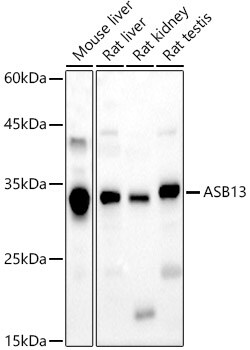
ABclonal Technology ASB13 Rabbit pAb
The protein encoded by this gene is a member of the ankyrin repeat and SOCS box-containing (ASB) family of proteins. They contain ankyrin repeat sequence and a SOCS box domain. The SOCS box serves to couple suppressor of cytokine signalling (SOCS) proteins and their binding partners with the elongin B and C complex, possibly targeting them for degradation. Multiple alternatively spliced transcript variants, both protein-coding and not protein-coding, have been described for this gene.
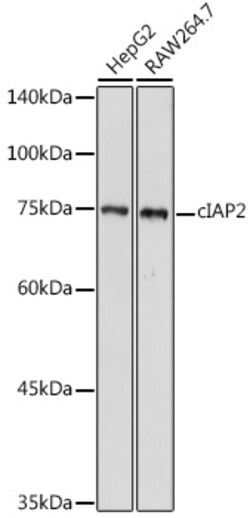
ABclonal Technology cIAP2 Rabbit pAb
This gene encodes a member of the IAP family of proteins that inhibit apoptosis by binding to tumor necrosis factor receptor-associated factors TRAF1 and TRAF2, probably by interfering with activation of ICE-like proteases. The encoded protein inhibits apoptosis induced by serum deprivation but does not affect apoptosis resulting from exposure to menadione, a potent inducer of free radicals. It contains 3 baculovirus IAP repeats and a ring finger domain. Transcript variants encoding the same isoform have been identified.